
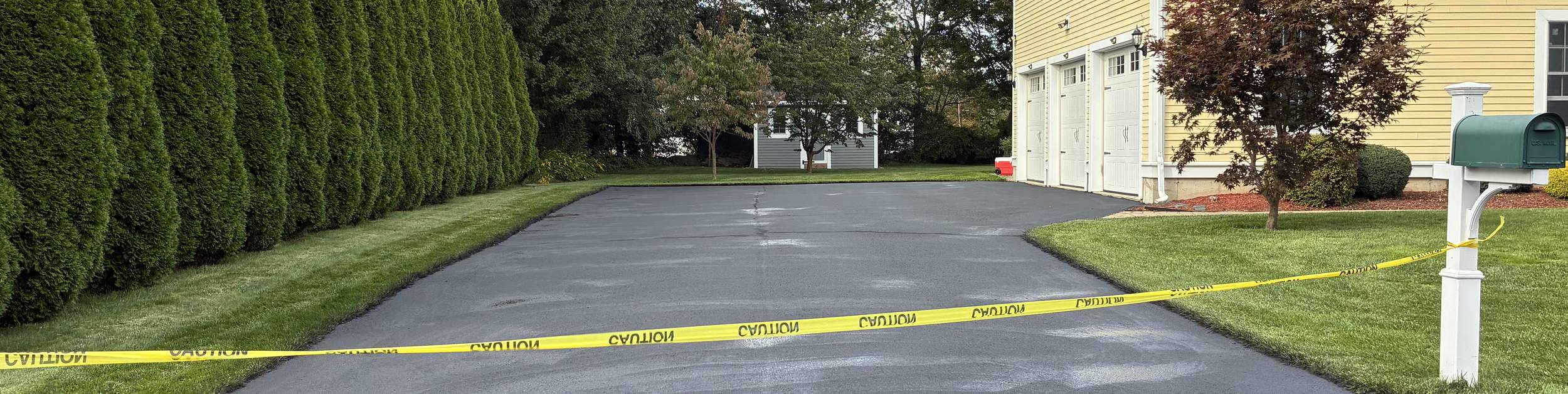
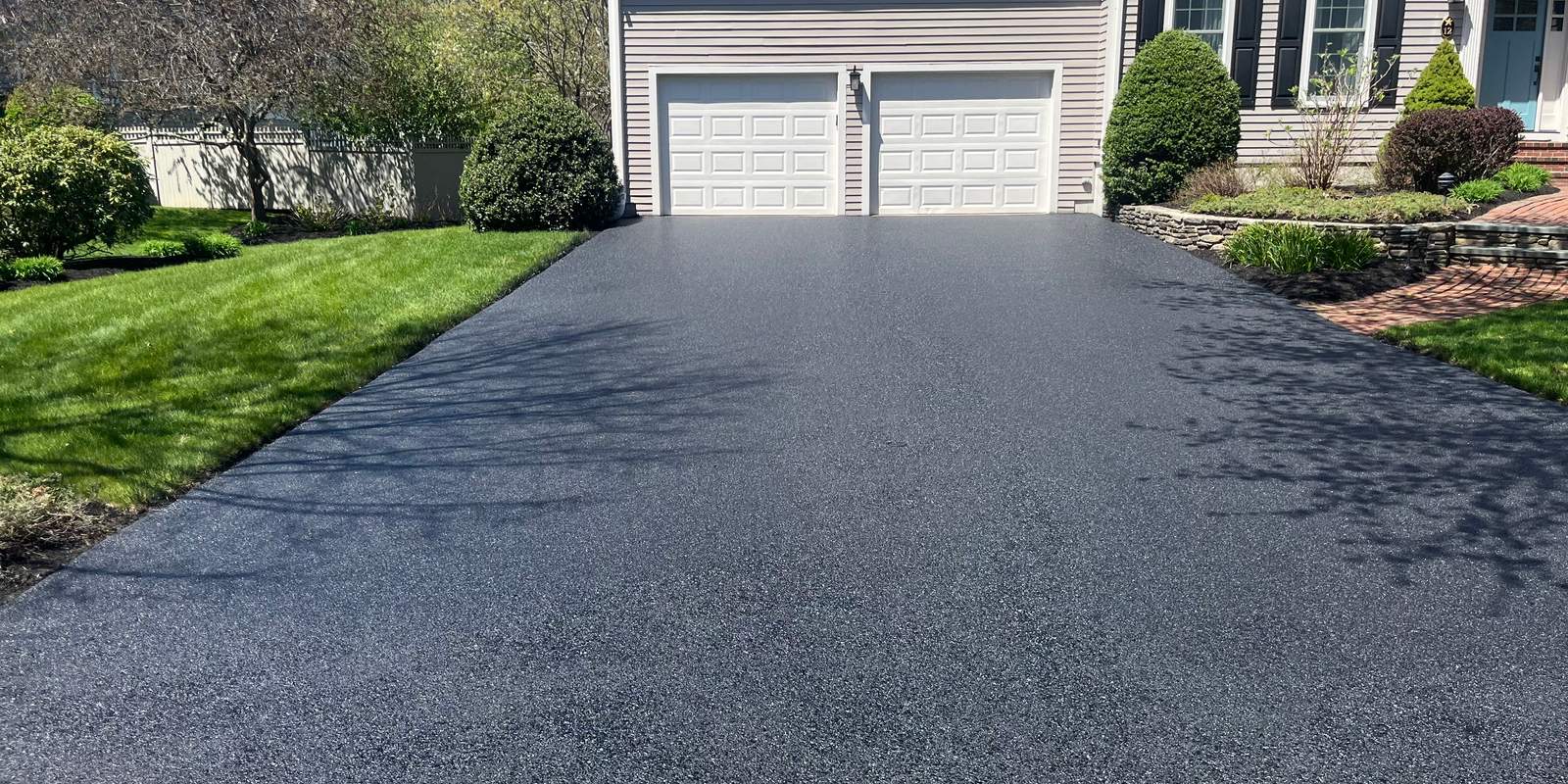

We get this question all the time: should I go with asphalt or concrete for my driveway? The honest answer depends on what you value most — and on the specific property you are paving.
Here is how the two stack up in a New England climate, with the real tradeoffs spelled out.
Quick Answer
For most residential properties in Massachusetts:
- Asphalt is the better all-around choice — lower cost up front, faster install, easier to repair, handles freeze-thaw cycles well when properly installed.
- Concrete makes sense in specific situations — long driveways where the upfront cost difference matters less over a 40-year horizon, high-end properties where the look of concrete fits the architecture, or homeowners willing to pay more for less maintenance.
The reason asphalt dominates South Shore driveways is not that it is better in every way. It is that it is better in the ways that matter most for the climate and the typical residential budget.
Lifespan
- Asphalt: 20 to 30 years when properly installed and sealcoated every 2 to 3 years.
- Concrete: 30 to 40 years with less routine maintenance.
Concrete wins on raw lifespan, but the gap is smaller than people think. A poorly installed concrete driveway can crack and fail in 10 years. A well-installed and maintained asphalt driveway can hit 30. Install quality matters more than material choice.
Cost
- Asphalt: lower per square foot, less site prep complexity, faster install — meaning lower labor cost too.
- Concrete: typically 40% to 60% higher upfront for the same square footage.
For a typical Massachusetts driveway, asphalt is the more affordable option by a meaningful margin. Over a 30-year horizon the gap narrows somewhat (because concrete needs less maintenance), but asphalt usually still wins on total cost of ownership unless the driveway is very large.
How They Handle New England Weather
This is where the comparison gets interesting.
Freeze-Thaw Cycles
New England has 30 to 50 freeze-thaw events per year. Water gets into small surface imperfections, freezes, expands, and stresses the material.
- Asphalt is flexible. It moves with the temperature and absorbs some of the stress.
- Concrete is rigid. When it stresses, it cracks.
Concrete cracking in New England is common and often hard to fix invisibly. Asphalt cracks are easier to fill and disappear after the next sealcoat.
Salt and Snow
- Asphalt tolerates salt fine. Plows can chip the edges, but the surface itself is not damaged by deicing chemicals.
- Concrete does not tolerate salt as well. Deicers that contain chlorides (most common ones) can cause surface scaling on concrete over time. You can use calcium magnesium acetate instead, but it is more expensive and many homeowners forget.
For a typical New England household that uses standard rock salt or ice melt, asphalt is the more forgiving choice.
Heat
- Asphalt softens in summer heat. On the hottest days, a sharp object (like a kickstand or chair leg) can leave a dent.
- Concrete does not soften.
In practice, this is a minor consideration in Massachusetts — we do not have many days hot enough to cause asphalt softening problems.
Appearance
- Asphalt is black when new, fades to gray over years. Some people like the clean, uniform black look; others find it boring.
- Concrete can be stamped, colored, or finished in various textures for a more distinctive look.
For high-end homes where curb appeal drives the decision, concrete sometimes wins on aesthetics. For most homeowners, asphalt looks perfectly fine and disappears into the property the way a driveway should.
Maintenance
- Asphalt: sealcoating every 2 to 3 years, crack filling as needed. Sealcoating is cheap.
- Concrete: occasional sealing optional, but generally lower routine maintenance.
Concrete wins here, but the asphalt maintenance is modest and the work is simple.
Repair
- Asphalt: easy to patch, easy to overlay, easy to repair invisibly with a sealcoat.
- Concrete: hard to repair invisibly. A crack stays visible even after professional repair, and matching new concrete to weathered concrete is nearly impossible.
If you care about the driveway always looking uniform, asphalt is more forgiving over time.
Time From Install to Use
- Asphalt: drive on it in 2 to 3 days, fully cure within a week or two.
- Concrete: do not drive on it for 7 to 10 days minimum. Some pros recommend 28 days for full cure.
Asphalt wins on getting your driveway back faster.
Which Should You Choose?
For most South Shore homeowners we work with:
- Choose asphalt if: you want lower upfront cost, faster install, easier repairs, and a material that handles New England freeze-thaw cycles well.
- Choose concrete if: you want maximum lifespan with minimum routine maintenance, you have the upfront budget, you like the look of stamped or colored concrete, and you commit to using non-chloride deicers in winter.
For very long driveways (over ~300 feet), the math sometimes favors concrete because the labor cost per foot drops while the lifespan benefit accumulates. For typical 60-to-150-foot residential driveways, asphalt is almost always the better choice in Massachusetts.
What We Do
We focus on asphalt paving — that is our specialty and where we can do our best work. If you want a concrete driveway, we will tell you that honestly and recommend you call a concrete specialist instead. We are not going to push you toward asphalt if it is not the right call for your property.
If you are weighing the decision and want a straight read, reach out for a free estimate and we will walk you through what makes sense for your specific driveway.