

Almost every asphalt driveway in Massachusetts will eventually crack. The question is not whether but when, and the answer depends on a few specific factors that most homeowners do not realize are in their control.
This post walks through the four most common reasons driveways crack in New England, how to tell which one is happening to yours, and what you can actually do about it.
1. Freeze-Thaw Cycles (the Most Common Cause)
What is happening
Water gets into tiny surface imperfections in the asphalt. When the temperature drops, the water freezes and expands by about 9 percent. That expansion forces the crack open a little wider. When it thaws, the crack stays slightly wider than it was. Repeat 30 to 50 times a winter, and a hairline crack becomes a fingertip-wide gap.
What it looks like
Freeze-thaw cracks usually start as hairline lines, often running in irregular patterns. They tend to appear after the first hard winter following install or following a missed sealcoat year.
What stops it
The fix is preventative: sealcoat every 2 to 3 years. Sealer fills the surface pores so water cannot get in, which means freezing cannot do its damage. Sealcoating is cheap insurance against this entire category of cracking.
If you already have hairline cracks, fill them with crack filler before sealcoating. The combination resets the clock.
2. Base Failure (the Most Serious)
What is happening
The asphalt you see is only the top inch or two. Underneath it is a compacted aggregate base, usually 4 to 8 inches of crushed stone. If that base was not installed deep enough, not compacted properly, or sits on unstable soil, it can settle or shift. When the base moves, the asphalt on top cracks.
What it looks like
- Alligator cracking — interconnected cracks that look like the back of an alligator. This is the classic sign of base failure.
- Sunken areas — sections of the driveway that have dropped below the surrounding surface.
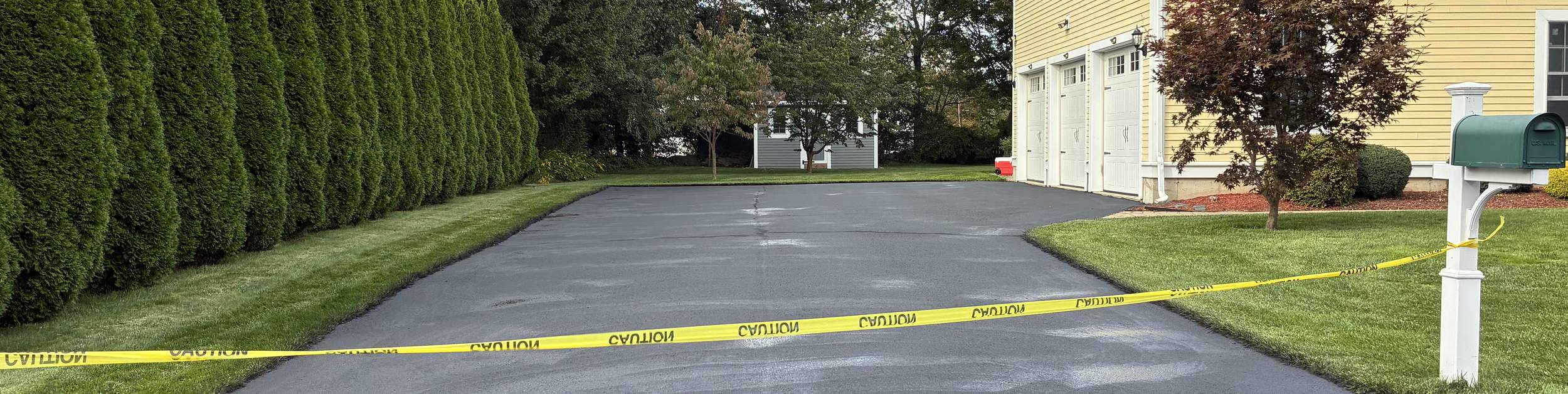
- Cracks that follow a pattern — like a line down the middle where two halves were laid separately and one side has settled.
What stops it
Honestly: nothing surface-level. Once the base fails, sealcoat does not fix it. Crack filler does not fix it. Even an overlay (laying new asphalt over the existing surface) only buys a few years before the underlying movement cracks the new layer too.
The real fix is a full replacement with proper base prep. That means removing the existing surface, regrading and recompacting the base, and laying fresh hot-mix asphalt. It is more expensive than a repair, but it is the only thing that actually solves the problem.
This is why install quality matters so much. A driveway with a properly prepped base might never have this problem. A driveway with a thin or poorly compacted base will start showing alligator cracking within 5 to 10 years.
3. Edge Wear and Cracking
What is happening
Driveway edges are the most exposed part of the surface. There is no asphalt on the outside of them, which means they have less lateral support. When cars regularly drive over the edge — backing out, parking close to the edge, turning across it — the asphalt at the edge breaks.
In New England, snowplow blades also chip and damage edges every winter.
What it looks like
Crumbling, broken, or chipped edges. Sometimes whole chunks come off near the street or at the transition to a garage.
What stops it
Two things help:
- Edge protection at install — a slightly thicker edge or a stone/concrete border absorbs the wear better than just terminating asphalt at the property line.
- Honest driving habits — try not to drive on or over the edge regularly. Where the driveway meets the lawn or landscaping, that edge is structurally weaker than the middle of the driveway.
When edges crack, they can be repaired with patch material before they spread further into the body of the driveway.
4. Reflective Cracking from Underlying Layers
What is happening
If a driveway has been overlaid (new asphalt laid on top of old) without removing the old surface, cracks from the old layer eventually "reflect" up through the new one. This typically takes 2 to 5 years to show up.
What it looks like
Cracks in the new surface that follow the exact pattern of cracks that existed in the old surface. Often along old seams, where two slabs of original asphalt met.
What stops it
Best to prevent it: when you replace a driveway, do a full tear-off rather than just an overlay if the existing surface has significant cracking. Yes, it is more expensive. It is also the only way to avoid this issue.
For an existing reflective-crack situation, the only real fix is full replacement when you are ready.
How to Tell Which Type You Have
Stand at the top of your driveway and look at the cracking pattern:
| Pattern | Likely cause | Action |
|---|---|---|
| Hairline lines, scattered | Freeze-thaw | Sealcoat + crack fill |
| Interconnected alligator pattern | Base failure | Full replacement |
| Cracks at the very edges only | Edge wear | Edge patching |
| Cracks following an old seam pattern | Reflective from underlying layer | Full replacement when ready |
If you have multiple types, prioritize fixing the most serious one first — base failure beats freeze-thaw beats edge wear.
The Honest Answer About Prevention
Most of what determines whether your driveway cracks early or late was decided at install. A properly installed driveway with regular sealcoating should run 20 to 30 years before it needs serious work. A poorly installed driveway might need replacement in 8 to 12 years no matter how well you maintain it.
If you are planning a new driveway, the single most important thing you can do is verify that the contractor is doing proper base prep. Ask about base depth (4 to 8 inches typical for residential), aggregate type (crushed stone, compacted in layers), and finished asphalt depth (2 to 3 inches typical). A contractor who answers these questions specifically is almost always going to do better work than one who waves the question off.
If your driveway is already cracking and you want a straight read on whether it is fixable or due for replacement, reach out for a free estimate. We will walk it with you and tell you the honest answer.
For more on related topics, see how often you should sealcoat and how long an asphalt driveway lasts in New England.